
If you spend any amount of time reading supplement labels, you’ll come across the words “Proprietary Blend” followed by a total weight and a list of ingredients. Sometimes it’s a small list. Sometimes it’s twenty ingredients deep. Either way, the individual amounts of those ingredients are usually missing.
This is legal. It’s also a source of a lot of confusion, and a long-running debate between brands that use proprietary blends and the customers who’d prefer not to guess what’s inside their capsules.
Here’s what the phrase actually means, where it comes from, and how to read a label that uses one.
What a proprietary blend is, in one sentence
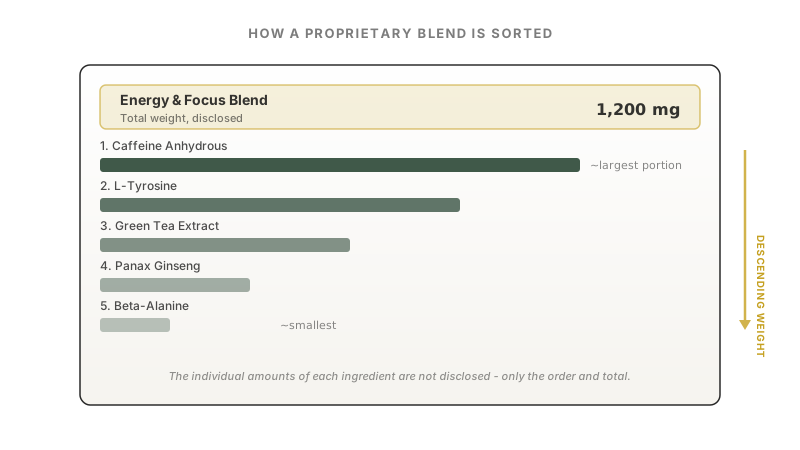
A proprietary blend is a group of ingredients combined under a single total weight on the Supplement Facts panel. The ingredients inside the blend are listed in descending order by weight, but the specific amount of each individual ingredient is not disclosed.
So a label might say:
Energy Blend – 1,200 mg
Caffeine Anhydrous, L-Tyrosine, Green Tea Extract, Panax Ginseng, Beta-Alanine
You know the total is 1,200 mg. You know caffeine is the biggest portion. You don’t know whether that means 800 mg of caffeine or 200 mg of caffeine – both are possible within this disclosure.
How the FDA regulates proprietary blends
Proprietary blends are allowed under U.S. Food and Drug Administration (FDA) regulations for dietary supplements, specifically under 21 CFR 101.36 – the rule that governs the Supplement Facts label.1
Under that rule, a manufacturer using a proprietary blend must do three things:
- Name the blend with a descriptive or company-chosen name (e.g., “Immune Support Blend,” “ProStrength Matrix”).
- List the total weight of the blend in milligrams or grams.
- List every ingredient inside the blend, in descending order of predominance by weight.
What they don’t have to disclose is the individual weight of each ingredient. That’s the trade-off the regulation accepts: some information is disclosed, some is withheld in the name of formulation privacy.
The FDA does not “approve” dietary supplements before they go to market. The label rules in 21 CFR 101.36 are labeling requirements, not approvals. Manufacturers are responsible for ensuring their products comply.2
Why brands use proprietary blends
The official reason is almost always formula protection. By withholding individual ingredient amounts, a brand can, in theory, make it harder for competitors to replicate the formula. This was more compelling in a pre-internet era when reverse-engineering a product required lab equipment and time. Today, third-party testing services can analyze most formulas in a few days, so the protection argument is weaker than it used to be.
There are other, less-stated reasons:
- Cost management. If the biggest-ticket ingredient is expensive, a brand can use less of it and hide that fact inside a blend.
- Marketing flexibility. The ingredient list at the top of a blend can be filled with well-known, research-backed ingredients, even if the actual amounts are too low to match the doses used in the research.
- Simplifying the label. A blend turns twelve individual rows into one, which can feel tidier on a crowded panel.
None of these are inherently bad. A brand can absolutely have a well-formulated proprietary blend with meaningful amounts of every ingredient. The issue is that a customer can’t verify that from the label alone.
What you can actually tell from the label
Even with a proprietary blend, a thoughtful reader can extract quite a bit:
- The total weight. This is always disclosed. It tells you the upper bound of every ingredient inside.
- The order of ingredients. The first ingredient on the list is the biggest. The last is the smallest.
- The number of ingredients. A blend with three ingredients at 600 mg total is very different from a blend with twelve ingredients at 600 mg total.
- Plausibility. If a 500 mg blend lists twelve ingredients and one of them is an ingredient that clinical studies use at 300-500 mg per serving, you can infer something about the likely dose.
What you can’t tell
The things a proprietary blend hides are often the things a customer most wants to know:
- Whether an ingredient is present at a research-supported amount. Most published research on supplement ingredients uses specific doses. Without knowing how much of an ingredient is in a product, you can’t tell if you’re taking a studied amount or a sprinkle.
- Whether you’re getting what you paid for. Two products with identical ingredient lists at the same total weight can have radically different concentrations of the key ingredient.
- How to compare products. Comparing two products with proprietary blends is nearly impossible. You’re comparing totals, not contents.
How to read a proprietary blend in practice
When you encounter a proprietary blend on a label, these four steps make it easier to assess:
1. Note the total weight
Write down (or remember) the total in milligrams or grams. This is your ceiling for every ingredient inside the blend.
2. Identify the first ingredient
This is the biggest portion of the blend. If the blend is 500 mg and contains 8 ingredients, the first one is at least 63 mg (the math: if everything were equal, that’s the minimum – in practice it’s almost always more).
3. Cross-reference against research doses
Look up the ingredients on a research-grade database like the NIH Office of Dietary Supplements Fact Sheets3 or Examine.com4 to find the amount typically used in studies. If the total blend weight is less than a single typical research dose for one of the ingredients, the blend can’t possibly deliver research-level amounts of everything on the list.
4. Ask the manufacturer directly
This is the most underused step. Legitimate brands will often disclose ingredient-level amounts on request, especially to a potential customer. An email or a customer service chat can give you information the label won’t. If a brand refuses to disclose, you’ve learned something too.

The transparency alternative
A growing number of supplement brands publish what’s often called a “fully disclosed” or “open label” formula. Instead of grouping ingredients into blends, each ingredient gets its own row with its own milligram amount. You can see exactly how much of everything you’re taking.
For the customer, open labels make comparison, research cross-referencing, and dose-checking straightforward. For the brand, it signals confidence in the formula – the reasoning being that if your amounts are good, you don’t need to hide them.
Open-label formulas aren’t inherently “better.” Well-designed products exist with and without proprietary blends. What open labels give you is verifiability. You can tell, from the label alone, what you’re taking.
Our formulas are fully disclosed. Every ingredient has its own row and its own milligram amount on the Supplement Facts panel. You can read the label and know exactly what you’re getting. Shop our range, see how we handle supplement label warnings, or contact us with any question.
Bottom line
A proprietary blend isn’t a red flag on its own. It’s a disclosure choice – legal, long-established, and sometimes justified. But it’s a choice that shifts information away from the label and toward the brand’s own documentation.
If you’re comparing products, if you care about matching research doses, or if you just want to know what’s in your capsules, an open-label formula gives you more to work with. If a blend is present, the tools above – weight, order, cross-reference, ask – will get you most of the way to an informed answer.
What to remember
- A proprietary blend lists multiple ingredients under one total weight, without disclosing the amount of each.
- The FDA allows them under 21 CFR 101.36, with required ordering and total-weight disclosure.
- You can still extract useful information from a blend: total weight, ingredient order, and plausibility.
- Open-label or fully-disclosed formulas list every ingredient and its amount individually – more useful for comparison.
- When in doubt, ask the manufacturer directly. Legitimate brands will share.
Frequently asked questions
What is a proprietary blend?
A proprietary blend is a group of ingredients listed on a Supplement Facts panel under a single combined weight, without disclosing the individual amount of each ingredient. The label shows the total milligrams for the blend, not the dose of each component.
Why do supplement companies use proprietary blends?
The stated reason is usually to protect a formula from competitors. In practice it can also let a brand include only a small amount of the headline ingredients while cheaper fillers make up most of the blend’s weight – something the label doesn’t reveal.
Are proprietary blends bad?
Not automatically, but they remove your ability to confirm that any single ingredient is dosed at a meaningful, research-backed amount, because the individual amounts are hidden.
How can I tell if a proprietary blend is underdosed?
Ingredients must be listed in descending order by weight. If a well-known “hero” ingredient appears near the end of the blend, it is present in a smaller amount than everything listed above it – often far below a useful dose.