If your easy runs feel hard and your hard workouts feel easy, you’re probably training in one undifferentiated “medium” zone all the time. Heart rate zones fix that. They turn vague effort into a number, so easy days stay genuinely easy and hard days actually count.
Here’s what the five zones are, how to find yours, and how to use them.
Get your numbers: the Heart Rate Zones calculator turns your age (and resting heart rate, if you have it) into all five zones in beats per minute.
What heart rate zones are
Your zones are percentages of your maximum heart rate — the ceiling your heart reaches at all-out effort. Each zone trains something different, from gentle recovery to peak power. The point isn’t to live in the top zones; it’s to spend the right amount of time in each.
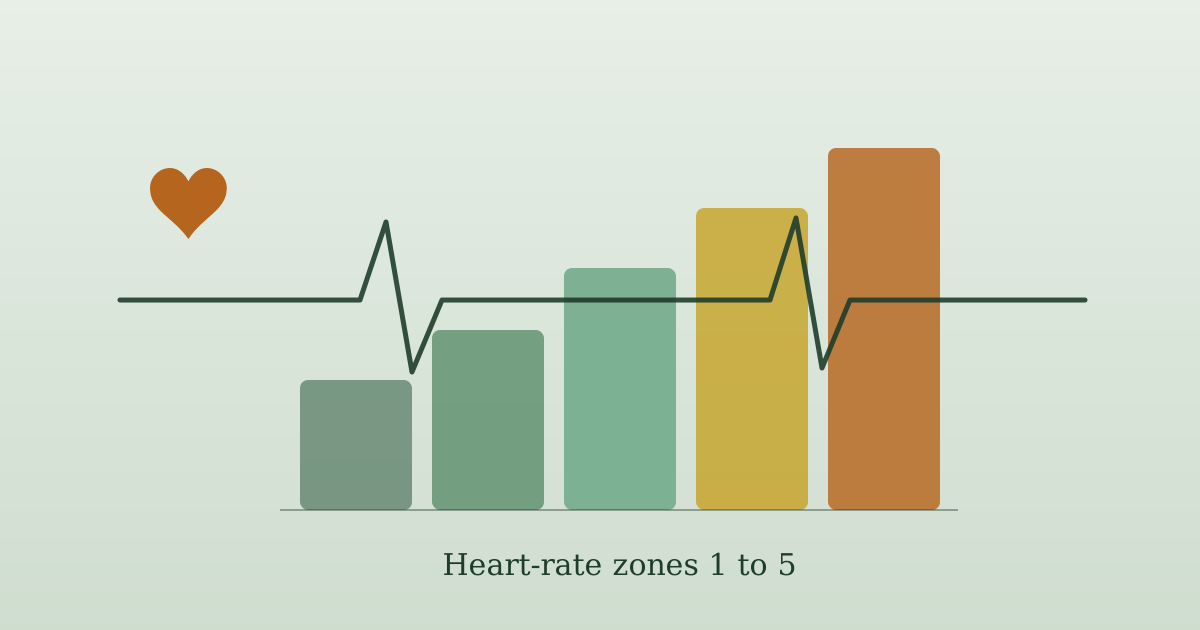
The five zones
- Zone 1 — Recovery (50–60% of max): very easy. Warm-ups, cool-downs, walking.
- Zone 2 — Endurance (60–70%): easy, conversational. Builds your aerobic base — most training should live here.
- Zone 3 — Aerobic (70–80%): moderate, “comfortably hard.”
- Zone 4 — Threshold (80–90%): hard, sustainable only for a while. Raises your lactate threshold.
- Zone 5 — Maximum (90–100%): all-out, short intervals only.
How to find your max heart rate
The old “220 minus your age” rule is popular but not very accurate. Research by Tanaka and colleagues offers a better estimate: 208 − (0.7 × age). For a 35-year-old that’s about 184 bpm. If you also know your resting heart rate, the Karvonen method personalizes the zones further by using your heart-rate reserve — and our calculator does that automatically when you enter it.
Formula-based max heart rate is an estimate and can be off by 10–12 bpm for any individual. A lab test or a few weeks of chest-strap data is more accurate.
Why most of your training should be easy
The most common mistake is going too hard on easy days, which leaves you too tired to go truly hard when it counts — so everything becomes a grey-zone slog. Keeping easy sessions genuinely easy (Zone 2, where you can hold a conversation) lets your hard sessions be hard. That contrast is where fitness is built. Many endurance athletes follow a roughly 80/20 split: about 80% easy, 20% hard.
Train hard, recover well
Adaptation happens during recovery, not just during the workout. Sleep, sensible nutrition, and replacing what you sweat out all matter — especially electrolytes like sodium, potassium, and magnesium when sessions get long or hot. If you want to see how much you’re losing, the Hydration Calculator factors in exercise and climate.
Frequently asked questions
- How do I calculate my heart rate zones?
- Estimate your maximum heart rate (a good formula is 208 − 0.7 × your age), then take percentages of it for each zone — for example Zone 2 is 60–70% of max. Entering a resting heart rate lets the Karvonen method tailor the zones more closely to you.
- What is Zone 2 and why does everyone talk about it?
- Zone 2 is the easy, conversational intensity (about 60–70% of max heart rate) that builds your aerobic base. It’s emphasized because it’s effective and sustainable, and because most people accidentally train above it.
- Is “220 minus age” accurate?
- It’s a rough rule of thumb that’s often off by a wide margin. The Tanaka formula (208 − 0.7 × age) is generally more accurate across age groups, and individual testing is better still.
This article is general fitness information, not medical advice. Check with a doctor before starting new or intense exercise, especially if you have any heart condition.