The label on a supplement bottle holds a surprising amount of information. Most people skim the front, read the ingredient list, and put the bottle in their cart. The warnings – which live on the back or side – often don’t get a second look.
That’s a missed opportunity. The warnings aren’t there for legal reasons alone; they’re the part of the label most likely to actually affect you. Drug interactions, allergens, age restrictions, and pregnancy notices all live in this section. Ten seconds of attention can prevent a reaction that takes days to recover from.
Here’s a walk-through of every warning section you’ll find on a compliant U.S. supplement label, in the order you’ll typically see them.
Why warnings matter more than most people realize
Supplements in the U.S. are regulated as a category of food under the Dietary Supplement Health and Education Act of 1994 (DSHEA).1 That means they don’t go through the same pre-market approval process as prescription drugs. The warnings on the label are, in many cases, the primary safety communication from the manufacturer to you.
A 2023 survey by the Council for Responsible Nutrition estimated that roughly three-quarters of American adults take dietary supplements.2 A large share of that group is also on at least one prescription medication. The warning section on a label is often the only place that flags potential interactions or contraindications that you might need to think about before taking a product alongside something else.
The Warning statement
This is the section usually printed in a box, marked with the word WARNING or CAUTION at the top, and intended to stand out visually. On a well-designed label, it’s the second thing your eye lands on after the product name.
A complete warning statement generally includes:
- Consult your doctor before use – especially if you have a medical condition, are taking medications, or are under 18.
- Pregnancy and nursing language – a statement that the product is not intended for use during pregnancy or while nursing, or a direction to consult a healthcare provider.
- Keep out of reach of children – a standard directive.
- Stop use and consult – instructions for what to do if an adverse reaction occurs.
- Ingredient-specific warnings – for ingredients that have known effects worth flagging (e.g., caffeine content, blood-thinning interactions, photosensitivity).
A generic “consult your doctor” line is boilerplate. Ingredient-specific warnings are where the real information is. If a product lists something like “contains caffeine equivalent to two cups of coffee” or “do not take with blood-thinning medication,” that is tailored information written because the ingredient actually warrants it.
The allergen disclosure
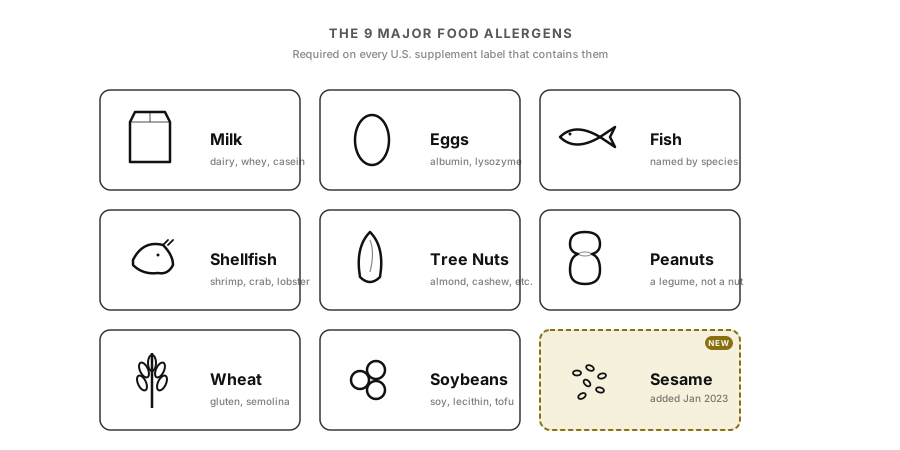
Under the Food Allergen Labeling and Consumer Protection Act (FALCPA),3 supplements – like packaged foods – must disclose the presence of any of the nine major food allergens recognized by the FDA:
- Milk
- Eggs
- Fish (with the species named, e.g., “cod,” “salmon”)
- Crustacean shellfish (e.g., “crab,” “shrimp”)
- Tree nuts (with the specific nut named)
- Peanuts
- Wheat
- Soybeans
- Sesame (added as the ninth major allergen effective January 1, 2023)4
This applies whether the allergen is an active ingredient (part of the formula intentionally) or an excipient (a binder, coating, or processing aid). If soy lecithin is used to coat a capsule, soy must be disclosed.
The “Contains” line
This is the simplest, most useful piece of allergen information on the label. FALCPA requires one of two formats:
- Format 1: The allergen is listed by its common name inside the ingredient list itself (e.g., “whey protein (milk)”).
- Format 2: A separate “Contains” statement immediately after the ingredient list (e.g., “Contains: Milk, Soy”).
Most supplement brands use Format 2 because it’s clearer and easier to scan. If you have a food allergy, this is the line you look at first – faster than parsing a twenty-ingredient chemistry list.

“May contain” and cross-contamination statements
You’ll sometimes see language like “Manufactured in a facility that also processes milk, soy, and tree nuts.” This is a voluntary statement – FALCPA doesn’t require it. Brands use it to flag cross-contamination risk when products are produced on shared equipment.
For people with severe allergies, “may contain” language deserves attention. For people with sensitivities rather than allergies, it matters less. Know which one applies to you.
The FDA disclaimer
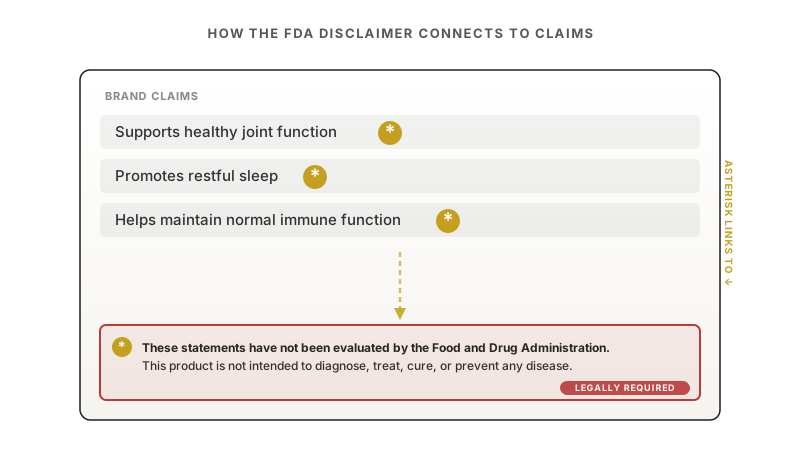
This is the paragraph you’ll see on virtually every supplement label that makes any claim about how the product supports the body. It reads, with small variations:
These statements have not been evaluated by the Food and Drug Administration. This product is not intended to diagnose, treat, cure, or prevent any disease.
This disclaimer is legally required when a dietary supplement label makes a structure-function claim (for example, “supports healthy joints” or “promotes restful sleep”). The rule comes from 21 CFR 101.93.5
What it means in plain terms:
- The FDA hasn’t reviewed or approved the specific structure-function claim on the label.
- The product is not a drug.
- It cannot treat a disease; if a label claims to treat a disease, that’s a different regulatory category (a drug) and the label is non-compliant.
A label without the FDA disclaimer is either making no structure-function claims at all (rare for supplements) or is not compliant with labeling regulations. Its absence is a yellow flag.
Age, pregnancy, and medication notices
Separately from the general warning box, some labels carry dedicated notices for specific use cases. These are most often:
Not for use under age 18
This shows up on adult formulas where the research base doesn’t include pediatric populations, or where ingredients are either more potent or less studied in children. If you’re shopping for a teen, this restriction matters.
Consult your healthcare provider if pregnant or nursing
Most supplements default to this language because the safety data in pregnant and nursing women is thin for many ingredients. A few supplements (prenatal vitamins, specific formulas) are explicitly designed for pregnancy; most are not.
Do not combine with…
This is where interactions show up. Common examples: “Do not combine with blood-thinning medications,” “Consult your doctor if taking SSRIs,” or “Avoid taking with monoamine oxidase inhibitors (MAOIs).” Every item on this list is there because a real interaction is documented. Treat them as binding.
Tamper-evident seal language
You’ll often see a line like “Do not use if seal is broken.” This is a safety callback to the seal that sits under the cap or around the neck of the bottle. If the seal is damaged when you receive the product, don’t take it – return or replace instead. This protects you from both tampering and from contamination that may have occurred in transit.
Expiration date and storage directions
These aren’t always framed as warnings, but they function as ones:
- Best By / Expiration: After this date, active ingredients may degrade. The product may not be unsafe, but it may not be as potent. Some ingredients (like omega-3 oils) degrade faster and can develop off-flavors or become rancid after expiration.
- Storage: Common language includes “Store in a cool, dry place,” “Refrigerate after opening,” or “Protect from light.” Deviating from these can cause degradation. If you buy a product that says “refrigerate” and keep it on a warm shelf, you’re not getting what the label promised.
What missing warnings tell you
A warning section that’s too short can be as telling as one that’s exhaustive. A few patterns to notice:
- No pregnancy/nursing language – either genuinely low-risk or a label-completeness issue. Most compliant labels include it.
- No allergen disclosure – if there’s no “Contains” line and the ingredient list is a pure chemistry list with no common names, the brand may have missed a labeling requirement, or there may not be any of the nine major allergens in the product. Check with the manufacturer if it’s not clear.
- No FDA disclaimer – if the label makes structure-function claims (“supports immunity,” “promotes recovery”) but lacks the FDA disclaimer, that’s a compliance gap.
- No expiration date – every compliant supplement label should have one. If it’s missing, don’t assume the product is unexpired; assume you don’t know.
Bottom line
The warning section is not marketing. It’s the part of the label where regulators and manufacturers have agreed on what you need to know before taking the product. Ten seconds reading it before the first dose is time well spent – especially for the first bottle of anything new.
If you take prescription medications, the specific-interaction lines in the warning box are the most important part of any supplement label. A quick conversation with your pharmacist or doctor before adding a new supplement to your routine is always a good idea, regardless of what the label does or doesn’t say.
Every Venasolla product label includes the full allergen disclosure, ingredient-specific warnings, age and pregnancy notices where applicable, and the FDA disclaimer. You can browse the full range – every label is shown in full – or read our companion guide on what “proprietary blend” really means. If you have questions about a specific ingredient before ordering, contact us and we’ll walk you through it.
What to remember
- The warning section is usually on the back or side panel – don’t skip it.
- Ingredient-specific warnings matter more than boilerplate language. Read them.
- The “Contains” line discloses the nine major food allergens. Check it if you have any food allergy.
- The FDA disclaimer is legally required when a label makes structure-function claims. Its absence is a yellow flag.
- Don’t use a supplement with a broken seal or missing expiration date.
- Always discuss new supplements with your doctor or pharmacist if you’re on prescription medication.
Frequently asked questions
Where are warnings located on a supplement label?
Warnings typically appear on the back or side panel, often in a boxed section headed WARNING or CAUTION. They are separate from the Supplement Facts panel and are usually printed in a bolder or larger typeface.
Are supplement companies required to list allergens?
Yes. Under the Food Allergen Labeling and Consumer Protection Act (FALCPA), supplements must disclose any of the nine major food allergens – milk, eggs, fish, shellfish, tree nuts, peanuts, wheat, soybeans, and sesame – whether the allergen is an active or inactive ingredient.
What does “Contains” mean on a supplement label?
The “Contains” statement lists the major food allergens present in the product in plain language, for example “Contains: Milk, Soy.” It appears directly below the ingredient list.
What is the FDA disclaimer on supplements?
It is the statement required on labels that make structure-function claims: “These statements have not been evaluated by the Food and Drug Administration. This product is not intended to diagnose, treat, cure, or prevent any disease.”